
What can we learn from the lessons of low carbon urban development in Chinese Cites over the last decade ?
"If we cannot measure, we cannot manage” - Managing global climate change is a data-driven decision process. However, when dealing with emission mitigation on the demand side particularly in the urban development and construction sector, we often fail to quantify and effectively measure the emission reduction effects of decisions, hence rendering any climate actions a "shot in the dark."
Ove the last decade, Chinese cities have been initiating, implementing and testing the impacts of specific urban planning and design interventions through the urban development process. Recently, quantification tools and primary project research have started to emerge to quantify the impacts of a range of actions on striving to carbon neutrality. These demand side interventions include spatial planning parameters such as transport oriented development TOD, non-motorized transport mode, street gird densities, compact urban forms, green spaces as well as Green Buildings and infrastructure, urban renewable energy and low carbon municipal services. What can we learn from these valuable experiences?
Over the last 16 months, I have been tasked to lead a team in Beijing, supported by the Energy Foundation, to research on and summarize all these experience and quantitative studies in Chinese cities over last decade into one single book to be used as reference by policy makers and the professionals in the urban development industry.
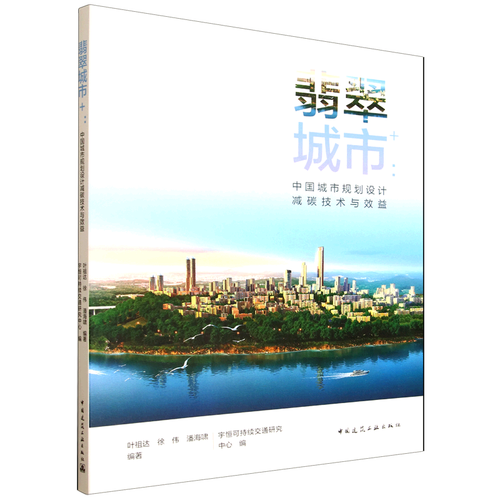
The outcome is the new book “Emerald City +: Accounting the Decarbonization Impacts of Low Carbon Urban Planning and Design on Chinese Cities” (Published by the China Architecture and Building Press in Chinese)
This new book offers responses on how and what can be measured. It is authored by Dr Stanley YIP (Past President of the Hong Kong Institute of Planners, Founder of NanRise Pte Ltd/G1X ) as the lead writer, contributed by XU Wei (Chief Scientist at the China Academy of Building Research), and Professor PAN Haixiao ( Expert in low carbon transportation at Tongji University, Shanghai).
This book begins with the foundational concepts of demand-side carbon accounting in urban planning and design. It explores policy specific methodological pathways and accounting methods to achieve carbon reduction through planning and design, providing a practical toolkit to assess the carbon impact of urban planning decisions. It is supported by more than 40 selected case studies in Chinese cities and their key accounting approaches employed to measure the impacts.
The book was launched on 20 November 2025 in the You Think Bookstore in Beijing. Dr Yip is planning to work on an English version of the book for overseas release in 2026.



Comments